
Many modern rifles on the market are well-made, durable options that will serve you well. I can also say the same thing for many older rifles. There is a plethora of rifles to choose from when considering a “hard use” rifle. But before we choose the rifle, we need to define its use. For today, our use is hunting, but as this series progresses, I will cover other uses as well. In my mind, there are two excellent designs for this application: the lever action and the bolt action. Which of these you would like to use should be among your first decisions. But maybe before that decision, we must decide on a caliber, due to certain designs only being offered in certain calibers, so let’s get into that.
When choosing a caliber, we need to further define our use. What are you hunting? Where are you hunting? What terrain should you expect? These are all excellent questions that must be considered. For my use, I am hunting Whitetail Deer in the Appalachian Mountains. The terrain I hunt in is full of dense woods and hills. Certainly enough terrain that the concern of a rifle bullet over-travelling and hitting something it shouldn’t, is not a concern. Knowing this, we need to examine appropriate cartridges for hunting deer in this area. Fortunately, most of the common deer hunting cartridges are more than suitable. Among the cartridges that I considered are 243 Winchester, 308 Winchester, 7mm-08, 264 Remington, 30-30 Winchester, and 35 Remington. The first 4 cartridges are traditionally offered in bolt-action rifles, while the latter two are provided in lever actions. There are also some newcomers on the scene, like the 350 Legend, 400 Legend, as well as the venerable 450 Bushmaster. These can be excellent options for those hunting in areas that require the use of straight-wall cartridges. Many also choose to hunt deer with a 45-70; however, I feel it is a bit much for deer, especially since I hunt for the meat and like to preserve as much as possible.
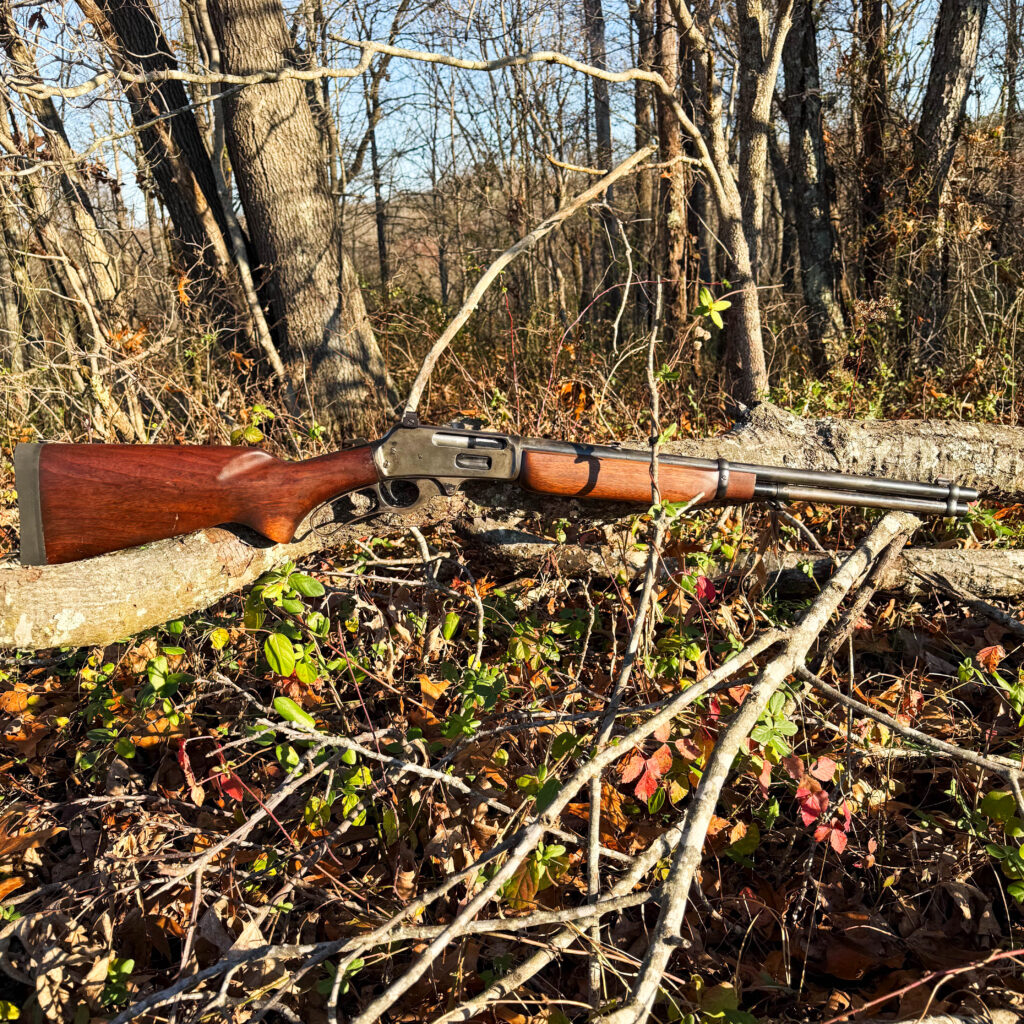
I know that in my area, the chance of me taking a shot at a deer much past 40 yards is uncommon, and farther than 200 yards is nearly unheard of. Most of my shots are in heavily wooded areas, but occasionally I take a shot across a clearing that is at most around 100-150 yards. So I know that I need are effective cartridge out to 150 yards, that performs well in dense brush, and comes in a fairly compact rifle, all while maintaining a light rifle that can be carried without extreme fatigue. Fortunately, there is an amazing, time-tested, and proven rifle, the 30-30 Winchester. I happen to have two 30-30s, one Marlin 336, and one Winchester 94. Both of these rifles are in the carbine configuration with 20-inch barrels, full-length magazine tubes, and Williams FP peep sights. Both rifles are equally capable, with the deciding factor being personal preference. While I enjoy both rifles, the Marlin 336 fits me better and has more features that I prefer. While both rifles are plenty accurate, the Marlin is slightly more accurate than the Winchester. Some folks may find the Winchester to be more accurate, but in my particular case, the Marlin wins by a slight margin. My runner-up choice, or my backup up is another Marlin 336, but chambered in 35 Remington. Some may ask why that isn’t my first choice, and the reason is that the rifle is a little newer to me, and I have not had the time to develop a good handload for hunting, and I do not have enough trigger time on it to be fully confident in its capabilities. By next season, I have plans for that rifle to be my primary, but for now, the 30-30 should be just fine.
So, what do I like about the 30-30 Winchester? The first thing is that the rifles are readily available, cost-effective, and typically reliable. Three of the most common 30-30s are the Winchester 94, Marlin 336, and Henry 30-30. I am fortunate enough to have access to all three of these, and I can vouch for all of them. The Marlin is my preference; however, all of them are fine rifles. There are some newer offerings like the Rossi and the Smith and Wesson, but due to my lack of experience with them, I will refrain from commenting on those models. The second reason I like the 30-30 is that the ammo is cost-effective and plentiful. While I do handload for 30-30, and that is the ammunition that I hunt with, if I go far from home and somehow run out or lose my ammunition, I can go to just about any gun shop or hardware store and find ammunition. The factory ammunition that I prefer is Remington green and yellow Core-Lokt 150-grain Soft Points. This is among the most plentiful in my area. Another reason that I like the 30-30 is that the cartridge is well-proven and time-tested. While I do like to test new things, I get wary of using unproven gear on a hunt, due to concerns of shooting a deer but not killing it. One of the common criticisms of 30-30 is that it is a relatively short-range rifle cartridge. In my experience, the 30-30 is good out to around 200 yards. For those familiar with Maximum Point Blank Range, my handloads give me a max point blank range of 195 yards. This means that my rifle is zeroed 2.5 inches high at 100 yards. I have a close zero of 15 yards, and a far zero of 167 yards. With this zero, I am within 2.5 inches high or low anywhere from the muzzle to 195 yards. For those who don’t know their maximum point blank range, you can go to shooterscalculator.com and find out. They do not sponsor me, and I receive nothing from them for referring you. I have just found them to be an excellent tool.
So we have the rifle caliber, and I have already spoiled the ending by telling you that I prefer the Marlin, but let’s go over some of the reasons I like it. First of all, it is one of the most proven designs. The 336 traces its lineage all the way back to 1893. It has undergone a few updates over the years, but we would expect that from any gun that has been around that long. The second reason is the pistol grip stock. I have shot several pistol grip rifles and several straight stock rifles, and from all of them, I find the pistol grip to be the most comfortable and shootable. Another thing that I like about MY particular 336 is the lack of a cross bolt or tang safety. I am a firm believer that lever-action rifles do not need a safety; that feature is negated by the “half cock” position of the hammer. I know some people like them, but I will not have a hard use lever action with a safety. Now, here is something that I despise, and unfortunately, most lever actions have them. Buckhorn sights. I see no need for the Buckhorn sight to still be in production. They are certainly no more accurate than a peep sight, and I have not found them to be faster either. They are also easy to knock out of alignment. So they are slower, less accurate, and less durable. Why are they still being used? Your guess is as good as mine. Lucky for you and I, most lever-action rifles are drilled and tapped on either the top or side of the receiver. For rifles that are drilled and tapped on the top of the receiver, I like to use the Skinner aperture sight, and for rifles drilled and tapped on the side, I like the Williams Fool Proof sight. Both are durable options, with the Skinner being slightly more compact and the Williams being more capable of fine adjustments.
Before we get too far, I want to make a disclaimer: just because I am currently hunting with a lever action in 30-30, does not mean that this is the only configuration that I find acceptable. Other cartridges are suitable; other rifles are up to the task. These are just my current choices. One choice that I would be ecstatic to have is a Winchester Model 70 or a Remington 700 chambered for the 308 Winchester. I have my eyes on a Winchester Model 70 Featherweight at the moment, but this is subject to change. Also, you will notice that none of my configurations have scopes. This is not due to my being anti-optic. I just find that I do not need them for where I am hunting. But it is likely that if I get a bolt action, I will get maybe a Leupold 1-5 optic to go on top of it.
So now we have a durable rifle, in a proven cartridge, with excellent sights. What do we need next? Practice, practice, and more practice. Many folks buy a hunting rifle, shoot a few rounds to zero it, and then put it in the closet until it is time to hunt. But this leaves a gap in proficiency. Have you tested to see how your ammunition performs? Have you experimented while shooting from various heights and angles? Have you tested which ammunition performs best from your specific rifle? Have you calculated and shot your hold overs, or done your maximum point blank range? I find all of these things hard to do while only shooting a few rounds at the shooting table at the range. And speaking of shooting tables, unless you hunt from a bench, I see no benefit in shooting from a bench, unless you are zeroing the rifle. After that, you should be shooting from field positions that you are likely to use. And if that means climbing up into the tree stand to shoot a couple of rounds, then go for it.
There are three major things necessary for proficiency: a good shooter, a good rifle, and good ammunition. And we practice to make sure that all of these things are functioning in harmony.
What I want to know from you is what your favorite rifle and cartridge combination is to hunt deer with? What is your most proven hunting rifle? Head on down to the comments and let me know.
Until next time, friends
Chuck