
**DISCLAIMER**
OUR GOAL AT THE PRACTICAL MARKSMANSHIP PROJECT IS TO SHARE WHAT WORKS FOR US. HOWEVER, JUST BECAUSE IT WORKS AND IS SAFE FOR US DOES NOT VOID YOUR INDIVIDUAL RESPONSIBILITY FOR SAFE PRACTICES. ALL LOAD DATA PUBLISHED BY US IS SAFELY WORKED UP BEFORE. WE ARE NOT RESPONSIBLE FOR THE CONSEQUENCES OF UNSAFE PRACTICES
Introduction
Welcome back, friends. As recurring visitors of the project know, I am on a quest to find my favorite 38 Special handload. 38 Spl. is the caliber that I am most likely to shoot. And that is for several reasons. One, I have plenty of guns chambered for it, or for the 357 Magnum. In guns like my Model 14 Target Masterpiece, the 38 can be loaded to exceptional accuracy levels. In my snub-nose carry guns, the 38 can make a formidable defense, offering adequate power, manageable recoil, and a plethora of ammunition to choose from. 38 Special is among the oldest handgun cartridges that are still in common use today, and it has always remained in production. The only time that I know of 38 Spl. ammo not being available is during massive ammo shortages, like the 2020 situation. And since the 38 Spl. has been so popular for so long, that means that folks just like you and me have been hand-loading ammunition for it for a long time as well.
There is one problem that I see with a lot of published 38 Special data. They are rather slow “target” style loads, and are not as well-suited to a combat handgun. Some people have pushed the envelope of 38 Special loads. In the past, some of those folk were the famed Elmer Keith and Skeeter Skelton. Nowadays, it is folks like Tim Sundles over at Buffalo Bore Ammunition. All of these names have produced excellent, safe, reliable 38 special loads that bring a lot to the table. But there are some problems here. I like to practice with the load, or a similar load to what I carry. And premium offerings like Buffalo Bore are too costly to shoot high volumes of. I am not saying the product isn’t worth the price; that is for you to decide. What I am saying is that I cannot go out and shoot drills or do some plinking with Tim’s ammunition. Two, certain practice or training 38 loads can be quite costly to shoot, especially in comparison to something like the 9mm. Another problem is that the vast majority of 38 Special loads that are sold as training loads feature soft lead bullets that can deform, or jacketed bullets pushed to a lower velocity. Many folks in the past have used Keith’s and Skeeter’s load data with great success, but there is one glaring problem with their loads.
At the time of writing, it is nearly impossible to find the Alliant gun powders that they used in their loads. For the past 5 years or so, Alliant powder has been scarce, and when I was able to find it, often it was more than double what some of the Hodgdon powders were. Since I started hand loading, I have primarily used Hodgdon powders, mainly because that is what my local store carried the best selection of. Had I known Alliant would just vanish from the shelves for the next 5-10 years, I would have stocked up. But hey, I guess I missed the memo.
The Premise
The goal of this load is to have an accurate, reliable, and safe 38 Special load that is affordable to load in bulk amounts. The bonus of this load is that I can make it dual-purpose. What I mean by that is if I can find one 158-grain bullet that is cheaper, and then find one “defense” style bullet like a Lead Semi-Wadcutter Hollow Point Gas Check of the same weight, that impacts the same point, and regulates well with the fixed sights on some of my revolvers.
There are a couple of things to be discussed with this. One is reliability. Certain people have certain needs for reliability. Those of us who are carrying the gun for defensive purposes, and are preparing to potentially use the gun in-harms-way require a high level of reliability. Those of us carrying these loads into a country where we might need to use them against dangerous animals require the same level of reliability. And no, this is not an admission that 38 Special is my dangerous game cartridge choice, but this is something I consider with all my loads, regardless of caliber. For the competition shooter, reliability is still important, but not as much. The price to pay for losing your life and losing a competition are two significantly different checks to sign. And for the Sunday plinker or casual range shooter, reliable carries far less importance. Really, the only reason this type of shooter cares about reliability is safety and convenience.
While we know that reliability can be more or less of a requirement or less, depending on use, there is one aspect that remains constant. And that is safety. It does not matter if your gun catastrophically fails; it matters not where it happened. A gun blowing up is a gun blowing up. And it is dismal at best, regardless of atmosphere. Safety is always paramount, and this should never be abandoned. If you need so much more power that you risk exploding a gun, then you need a bigger caliber. Which may seem strange for me to say, being that I am writing a series based on loading outsid epublished max data, but there is a significant difference. I believe that CERTAIN LOADS can be safe above traditional max published data. There is also the consideration that many load manuals disagree with one another as far as what the “safe maximum load” is or should be. I regularly use 5 or more load sources, and in them can be found a plethora of disagreements on minimum and maximum loads. So how do we know who is right? We test it ourselves.
Where We Started
Originally, when we started the 38 load development, we started with published load data for the components that I had on hand. Those components included Missouri Bullet Company .357 ACTION 158 grain Hard Cast SWC bullets, CCI NO. 500 primers and an assortment of powders. Those powders are Winchester 231, Hodgdon Tite Group, and Hodgdon HS-6. After some preliminary testing with published load data from those three powders, I found that Winchester 231 Ball performed the best for me. So that is the powder I elected to go forward with. It didn’t hurt that I had over 10 pounds of W231 on hand already. Then it was time to crank it up.
Once we had tested up to the max published load, we incrementally stepped up by approximately .5 grains and did a test run with each batch. Our max load from that testing was a 6.0-grain charge of W231 that gave us some impressive numbers. We saw an average velocity of 1,093 FPS, a standard deviation of 6 feet per second, and an extreme spread of 15 feet per second. Certainly the best performance I have ever seen from a 38 Special, if you have a load that you have seen better performance out of, I sure would love to hear about it.
The Problem
So you may be asking yourself, “If you saw such fantastic performance, don’t fix what’s not broken”. But I encountered an issue in this development. Initially, when I develop a 38 Special load, I do it in my 4-inch Smith and Wesson 686. During the initial testing, we saw no issues with extraction or any other signs of excessive pressures. But on the next range trip with more of this ammo loaded up, we started to see sticky and difficulty with extraction. This was present in all guns I tested this ammo with, except for my S&W Model 28 Highway Patrolman. With this being discovered, I now have to back this load off until the extraction issues go away.
The second issue I saw with this load is that, upon further testing, I found it to not be as consistent as the initial test loads were. I am now forced to a realization, I just so happened to find a unicorn group. This means that I got lucky on that initial group. With subsequent testing, using the same gun, chronograph, components, and loading procedures, these results were not repeatable. Good science is verifiable, falsifiable, and repeatable. Unfortunately, these results were not repeatable.
****WARNING****
THIS LOAD DATA IS OVER PUBLISHED MAXIMUM LOAD DATA. IF YOU CHOOSE TO USE THIS DATA, PLEASE WORK UP YOUR LOADS SAFELY. ALL GUNS HANDLE AMMUNITION DIFFERENTLY. JUST BECAUSE THIS WORKS FOR US DOES NOT MEAN IT WILL WORK FOR YOU. WE ARE NOT RESPONSIBLE FOR THE CONSEQUENCES OF UNSAFE PRACTICES.
The Solution
So the basic and obvious answer is to just back off the load, right? But what do we back it down to? What increments do we step down by? The answer I have come up with is to load test batches that are backed off in 0.2 grain increments. We will walk back from 6.0 grains of W231 to 5.8, then 5.6, 5.4, and finally back to 5.2 grains. While we already tested 5.6 grains and got decent results, I want to test it again to make sure that I don’t have any pressure issues with it. There were no initial pressure issues, but one can never be too careful when working above published max loads. I also had some standard pressure W231 loads worked up at 4.6-grains, just as a benchmark for published loads.
Another potential answer to fixing pressure issues is to adjust the bullet seating depth. However, the bullet I am using only features one crimp groove. And I tend to prefer a heavier crimp. So, for the time being, I will be keeping the bullet seating depth the same.
Another possible solution would be to change up the powder. I could move to a lower-pressure powder that I would be able to do a higher charge of. This is a possibility, but then I am left with this surplus of W231 powder that needs to find a home. And while we are on that topic, if you happen to have a favorite W231 recipe, I would love to hear about it in the comments.
The Results
I want to detail my loading procedure, so that either you can be confident that I am not missing something, or maybe you can point out a flaw. For brass prep, the brass is thrown in a vibratory case tumbler with corn cob media and allowed to tumble for approximately 2 hours. This removes the bulk of the dirt and grime and helps to keep my full-length sizing die clean. After the corn cob tumble, the cases are then lubed and full-length resized. I currently use Hornady One Shot case lube, and the dies I use are Lee Precision. Of course, the press is my RCBS Rockchucker Supreme. After the cases are dry tumbled and resized, they then go into the wet rotary tumbler. I tumble them with stainless steel pins and Frankford Arsenal wet tumbling detergent. They are left in the rotary tumbler for approximately 3 hours. After that cycle is finished, I throw them in the Frankford Arsenal case dryer at 160 degrees F for 5 hours. Once the cases are dry, they are placed in bins and checked to see if they need trimming. I do not check every piece; rather, I batch check around 15 pieces per 300-piece bin. If they need to be trimmed, they also get chamfered and deburred. When trimming is needed, I do it in the Lyman Universal Trimmer. After all of this, they are ready to be loaded.
Now, let’s get into actually loading some ammo. I start by priming the cases on my RCBS Bench Primer. I primed these cases with CCI #500 Standard Small Pistol Primers. After priming the cases, they are then flared at the mouth to accept the bullet. Post flaring, the cases receive their respective powder charge from the RCBS Uniflow 3 powder measure and then are topped off with the appropriate bullet for the load. After all of this, the cases receive a roll crimp from the Lee Precision Factory Crimp Die to finish them off.
The day we went out to begin testing, it was overcast and around 60 degrees. We already knew that in some guns the 6.0 grains of Winchester 231 Ball was too much. Notably, the Model 686 was having some stiff extraction with this load. So, this is where we started. Surprisingly, we saw no stiff extraction this time with the 6.0 grain load. The only thing I can think of that would cause this discrepancy is the fact that I thoroughly scrubbed the chambers after the last range trip. Initially, one may think that we could just continue with this load, but this is not the case. I did not see the initial stellar performance that we once saw. With that being said, let’s go over what we saw.
All numbers expressed are velocity in Feet Per Second
Winchester 231 Ball, 6.0 grains
- Average: 1114
- Minimum: 1089
- Maximum: 1143
- Standard Deviation: 17
- Extreme Spread: 53
Winchester 231 Ball, 5.8 grains
- Average: 1061
- Minimum: 1026
- Maximum: 1104
- Standard Deviation: 27
- Extreme Spread: 77
Winchester 231 Ball, 5.6 grains
- Average: 1048
- Minimum: 1024
- Maximum: 1083
- Standard Deviation: 24
- Extreme Spread: 59
Winchester 231 Ball, 5.4 grains
- Average: 1006
- Minimum: 979
- Maximum: 1046
- Standard Deviation: 25
- Extreme Spread: 67
Winchester 231 Ball, 5.2 grains
- Average: 988
- Minimum: 948
- Maximum: 1038
- Standard Deviation: 31
- Extreme Spread: 90
Winchester 231 Ball, 4.6 grains
- Average: 901
- Minimum: 863
- Maximum: 944
- Standard Deviation: 29
- Extreme Spread: 81
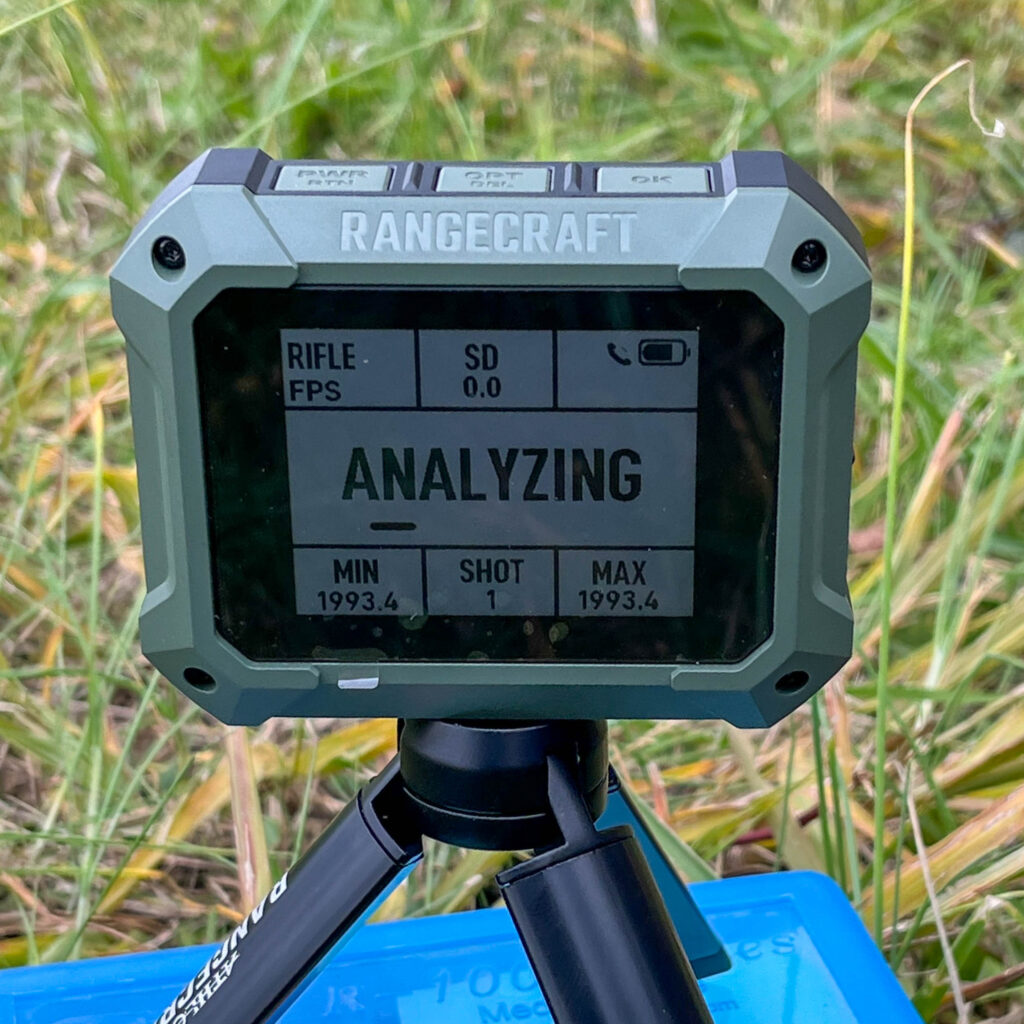
Aside from the powder charge, the loads were identical. Primers, powder, and bullets were all the same and from the same lots. There were control groups of 6 rounds fired for each charge. All rounds were chronographed using the Athlon Ballistics Pro Radar chronograph. I do not have any targets to show for accuracy, due to my forgetting them that day; however, the numbers will give us a good idea of what works. I will go back another day and shoot some targets to see how accurate I am on paper, and those results will be published at the bottom of this article. All that said, let’s look at some results.
Next Steps
Some of these were okay; however, none of them were exceptional. I would like to find one that is. My next evolution in this series is to perform more in-depth testing of published loads. Working with data from my Hornady loading manual, I will be testing safe, published data for both standard pressure and +P loads, working from the minimum to the maximum, in 0.3-grain increments. Stay tuned for that.
In the meantime, I would like to hear from you. What 38 Special loads are your favorite? What is your favorite 38 Special powder and bullet combination? Head down to the comments and let me know.
Until next time, friends
Chuck