
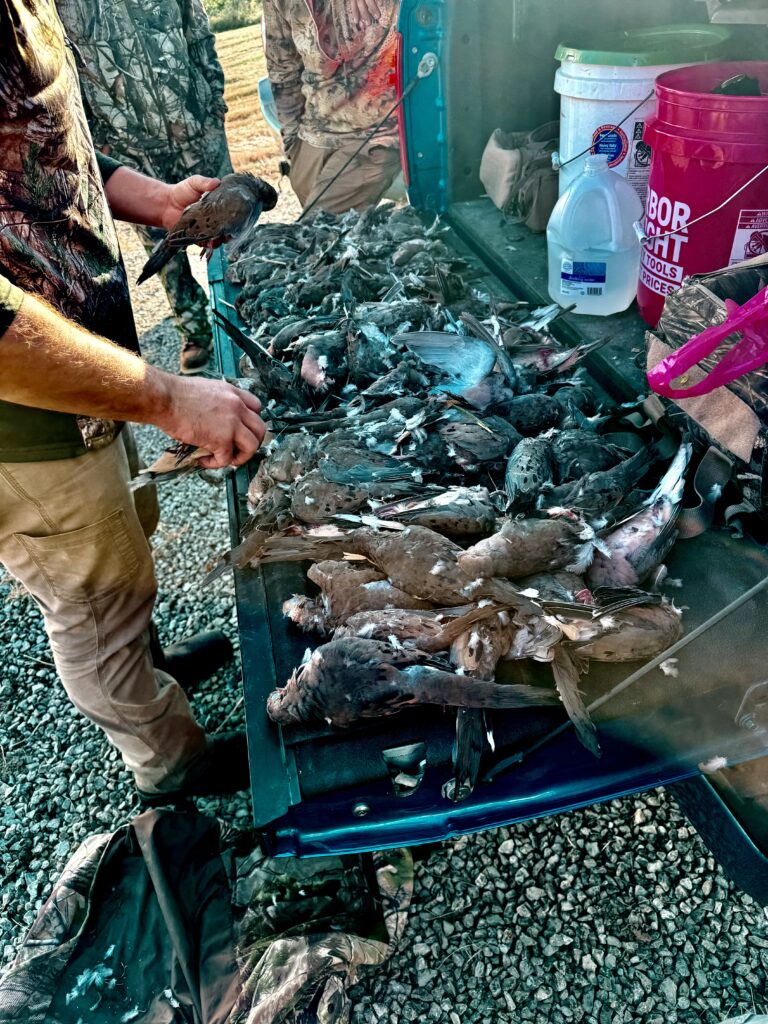
It is not too often that I get the opportunity to do something new in the shooting/hunting world, but when that scarce opportunity rolls around, I pounce on it. And that is exactly what I did. I will be up front on the fact that I do not have a ton of hunting experience, and the experience that I do have is mostly upland birds and whitetail deer. However, Garrett has far more hunting experience than I. And even more important, he has far more locations to hunt than I. During the many hours we spend at the reloading bench, the topics of conversation are as wide as a barrage of rifle fire. One evening, he was talking about a mourning dove hunt that he had gone on the day before. He detailed how well it had gone and how much he enjoyed hunting doves. From the fast-paced nature of the doves flying in, to the erratic flight patterns, and of course, the difficulty of hitting a target that small moving at the speed they do. I had told him that I had never gone dove hunting before but would love to try it. As fast as he could get his phone from his pocket, he was calling folks to see when we could set up ur next hunt. About 5 minutes later, we had a hunt scheduled for a few days later, during the upcoming weekend. But that begged a few questions on my behalf. What do you hunt doves with? What gear did I need to bring? How do you clean a dove? And what kind of permits do I need to hunt these birds? So for those who have never done this type of hunt, let’s go over that.
Preparing for the Hunt
So we will get the boring part out of the way. In the state we were hunting, the only permits required are a state hunting license and a survey that is required for all migratory bird hunting. The survey is free to complete, but it requires to have proof of completion. And of course, always have your hunting license with you. In my state, it is required to take a Hunter Safety Course for those who haven’t completed one. But once you complete it, it is not necessary to recertify for future seasons. If you are hunting on land that you have permission to hunt, in my state, it is required that the person who has permission carry the written permission form on their person. Fortunately for this hunt, one of the participants owned the land we hunted, so we did not have to worry about a permission slip. Of course, all of this is for my local area. Please check your local laws to see what permits and licensing are required. It is far cheaper to pay the license fees than it is to get busted for hunting illegally. And for those who choose not to complete this step, don’t complain when you get caught. But enough on the boring part, let’s get to the fun part.
And of course, the fun part is gear. While there are companies that manufacture specific hunting equipment for dove hunting, I did not own any of that, and didn’t want to spend the money to get some, just to wind up not liking that type of hunt (spoiler alert: I loved it). While I did not have any dove hunting equipment, I did have some pheasant hunting gear, and I figured that would be close enough until I upgraded my gear. My gear for pheasant hunting is a Cabela’s Upland Game vest. It features shoulder padding, plenty of pockets, two front shell pouches, and some sewn elastic loops inside those pockets to hold some quick reloads. And no game vest would be complete without a game bag. My game mag stretches the entirety of the back of the back. This game bag provides more than ample space for a dove hunt where you reach your limit, with plenty of space to haul a few extra birds in case a friend does not bring their own game bag.
And now the part we all love to discuss. What shotgun did I take? I have two favorite hunting shotguns, and they are both double-barreled shotguns. One of them is a Fox Model B 20 gauge side by side, with fixed choke barrels, an automatic safety, a single trigger, and a “beavertail” style forend. This gun is one of my favorites for a couple of reasons. One of the benefits is that it is light and handy to carry afield for the day. Anyone with normal-sized hands should be able to carry it by the receiver, or do the traditional “open action, over-the-shoulder” style of carry. And this shotgun is chambered for 20 gauge, with 3-inch magnum chambers. But the big reason I like this gun is more than its characteristics. This gun was given to me by my grandfather. It was given to him by my grandmother as a wedding gift on their wedding day, and it was the gun that he carried and hunted with for many, many seasons, and saw great success. While I love that shotgun, both for its physical aspects and the sentimental value, I hate to use and abuse my heirloom gun, so I went and bought a second gun to take some of the wear and tear.
That second gun is a CZ Drake. An over-under double-barreled featuring a manual safety, extractors, a single trigger, a deleted mid-rib, and a slim, trim profile. This gun is chambered in 28 gauge with 3-inch magnum chambers, which has quickly become my favorite gauge for upland bird hunting. I find that it gives me plentiful lethality out to about 50 yards, but does not throw so much shot that if I take a close-range shot, it will mutilate the birds. This is a problem I ran into with my Remington 870 Super Magnum 12 gauge.
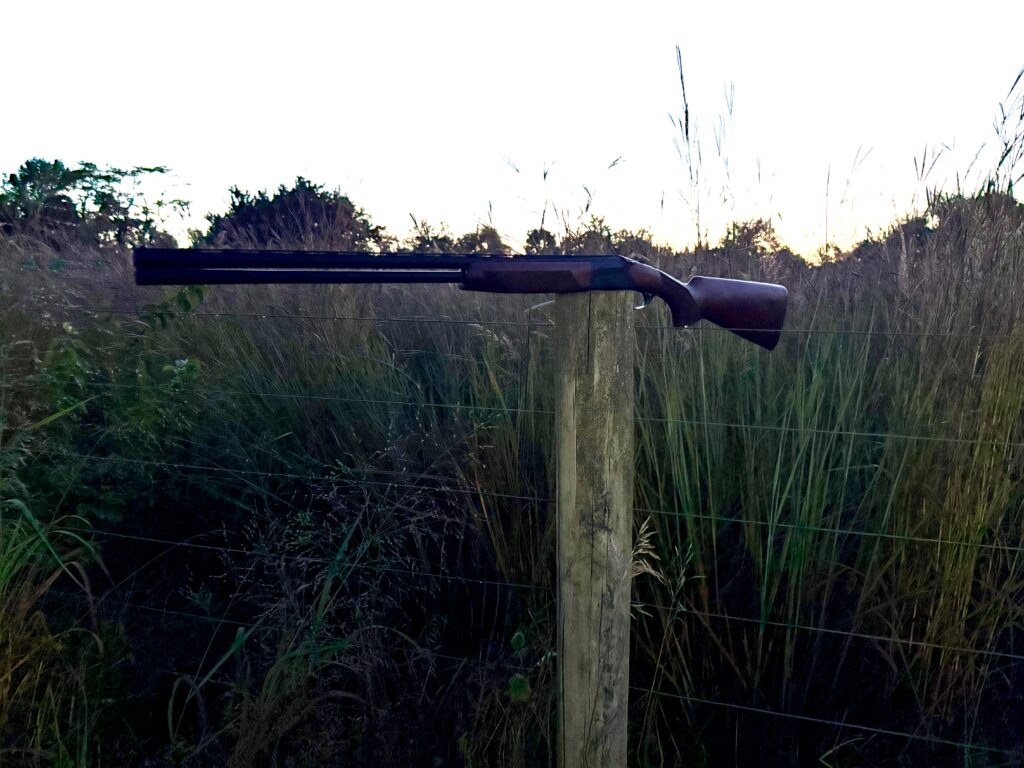
Chuck’s CZ Drake in 28 Gauge
It is worth discussing ammo as well. On this hunt, I used some standard clay loads. Federal Top Gun 7.5 shot to be exact. This has been one of my favorite loads for general-purpose shooting. However, I have encountered an issue with this ammo recently. I picked up a MEC 600 JR. Mark V to start handloading my own 28 gauge ammo. While reloading this ammo, I began to notice cracks in the hull near the base of the fold crimps. Mind you, this occurred after the first firing; these hulls had not yet been reloaded. I have been sorting through the hulls. Hulls that are not cracked get to stay in rotation, and hulls that are damaged or deformed get discarded. I will load up the rest of the hulls and then switch to Winchester AAs. I have loaded several batches of AAs without issue. No cracks, no miscrimps, no trouble. While I like Federal ammunition, these particular hulls do not seem to be well-suited for reloading. Once I have enough hulls on hand, I will be developing a load that pushes 7/8 ounces of 7.5 shot around 1200-1300 feet per second. But now I am getting outside the purpose of this article. Let’s get back on track, shall we?
The Hunt
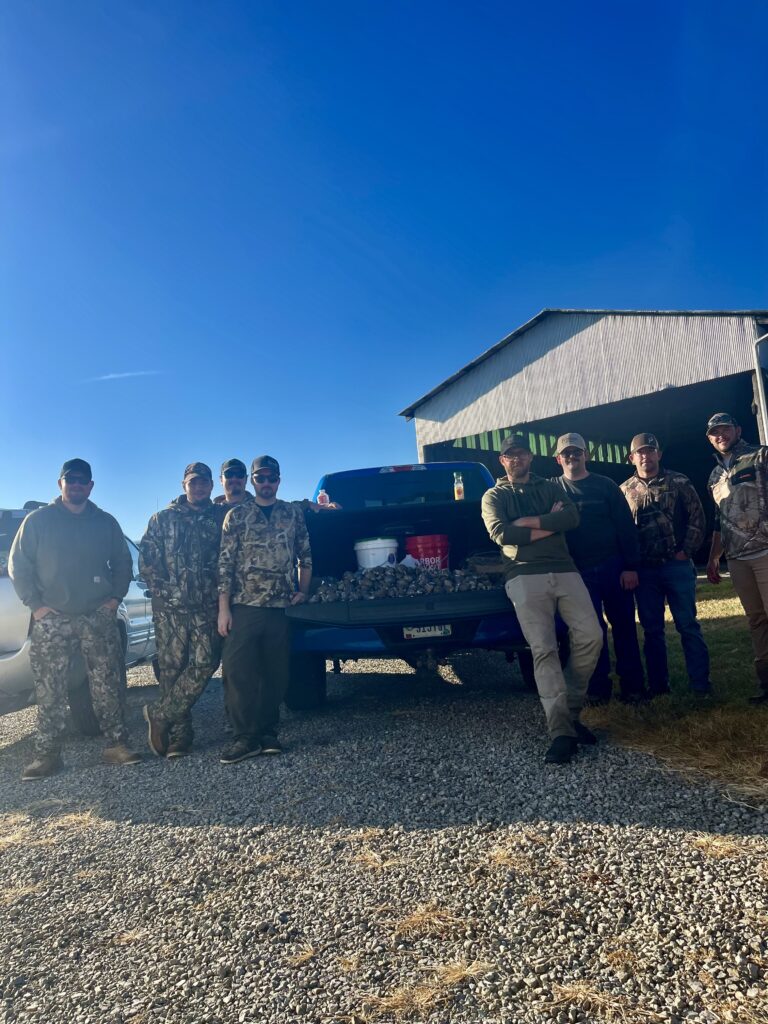
The morning of the hunt, I woke up around 0500. I got all my gear packed and headed out to the barn to meet the hunting party. I brought the shotgun, a couple of boxes of ammo, my vest, a knife, and a bucket to sit on. When we all made it to the barn, we enjoyed our coffee or energy drinks, then got our guns assembled and headed out to the spot. We had 8 men in the party, so we elected to split into two groups. One group of 4 would hunt the edge of a clay pit with some cover, and the other group would hunt a fence line with heavy cover behind it. These two locations allowed us to spread out into more manageable groups, and the directions of fire eliminated any chance of anyone shooting anywhere near the other group. I was in the group that went to hunt the fence line. We got out to our spot around 20 minutes before the shooting time began. We got all of our decoys placed, each man spread out along the fence line, and then we waited for the birds.
The first flock of doves flew in around 4 minutes after the legal shooting time. We all mounted our guns, picked a bird, and made the shot. The first man dropped his, I and the other man missed, and I heard Garrett say, “What the hell is this?”. Now of all things I was expecting to hear in the dove fields, that wasn’t it. I looked over to see what had happened. I could see the bolt in his autoloading shotgun locked partially open, with a spent hull halfway in the chamber. Another hunter and I set down our guns and went to see what the problem was. It seemed there was a piece of debris that had become lodged in his action and caused the gun to lock up. So we field stripped the gun and attempted to get it out. There was a small piece of black debris that fell out of the receiver, and then the bolt freed up. With the gun back in action, we resumed positions and waited for the next flock to fly in.
Sure enough, the next flock came in around 5 minutes later. This time myself and one other got birds on the ground, but again, Garrett’s gun had locked up. By this time Garrett was becoming quite frustrated. He was using an older autoloading shotgun that he enjoyed shooting a fair amount, and we hadn’t seen this kind of problem before. It is also worth mentioning, Garrett and I both made a rookie mistake. Neither of us brought spare guns. So again, we tear the gun down and work to get it cleared and functional and wait for more birds. But each time the birds would fly in, the three of us would get shots off, and Garrett was still attempting to get his gun back into action. This was a crying shame because there were doves aplenty. So many doves that three of us shot our maximums, and one handed his gun off to Garrett, and Garrett was able to also fill his limit. With the limits filled, we headed back to the barn. The other team had beaten us back to the barn by a few minutes, and we were all surprised. All eight of us had shot our limits. No man walked away empty-handed. Where we were hunting, there is a daily limit of 15 doves per person, which left us with 120 doves to clean.
Cleaning Up
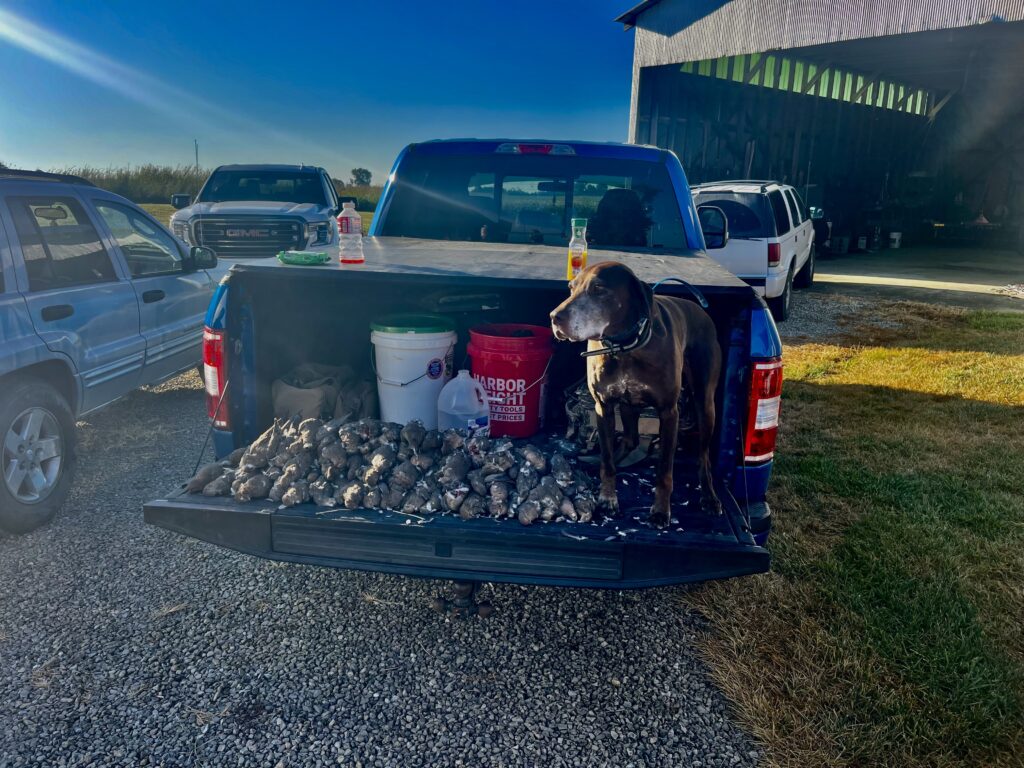
With 120 birds to clean, we all had to pitch in. Now I had never shot a dove, nor had I cleaned one. So I jumped in line with the other man who was separating the breasts from the skinned birds. It didn’t take too horribly long to get all the birds cleaned, packaged, and separated among the men. While cleaning birds, the Game Warden was passing by and stopped to talk to us. He checked hunting licenses, guns, and ammo. A couple in the group didn’t read up on the local laws and didn’t know that they needed plugs in their guns. I would have given them some, but I didn’t have any with me since I was shooting a double-barreled. So they got some tickets, and then the warden was on his way. This just further reinforces my point that you are just better off abiding by federal, state, and local laws for this kind of thing. Those fellas will tell you that those are the most expensive doves they have ever shot.
With all the birds cleaned, it was time to head back to my house and figure out what in the world was going wrong with Garrett’s shotgun. Once back at the house, he and I tore the gun down and found a ton of black plastic shavings falling out of the receiver. After further examination, we found that the recoil buffer had become brittle after years of use and shattered in the gun with his first shot. So on to the internet we went to find a new one. But for the next few hunts, Garrett elected to use his Mossberg 835.
What Comes After
What comes after? Another dove hunt, of course! That hunt was one of my favorite hunts I had ever been on, and I couldn’t get my fill of it in just one day. So it wasn’t but a few more days, and we were out on our next hunt. Now I must admit, I committed a cardinal sin for a man who writes about guns. I took zero pictures on the second hunt. None of the birds, none of the group, no pictures to speak of. There was no particular reason for this, other than I simply forgot to do it. So my apologies for being unprepared. But the results weren’t as stellar as the first. The second hunt was 6 men, and nobody shot a limit. In fact, I only dropped two birds. I fired at six, but due to my unfamiliarity with the erratic flight pattern of doves, I only dropped two of them. I know, I know, shame on me. But 2 doves are better than no doves. And it is hard to complain about a morning spent in the dove fields. Even if there weren’t very many doves flying.
Lessons Learned
So I learned several things from this whole experience. The first of them being what it was like to hunt doves. And for those who haven’t done it, I cannot recommend it enough. It is fast-paced, with quick targets that will give you a run for your money. The second thing I learned was how to clean doves. I won’t go into too much detail on this because while I did clean approximately 60 doves, I still feel that there are better resources for that information than what I can provide. However, there was one lesson that Garrett and I were reminded of. Always bring spare guns and ammo. We have both been hunting long enough to know this, but why we both forgot at the same time, I do not know. But please, friends, heed my advice, take spare gear and save yourselves the disappointment and headache. From now on, both my CZ and my Fox will be accompanying me afield, with plenty of ammo for each. All in all, I have definitely become hooked on dove hunting, and at the time of writing, I currently have two more hunts planned.
As always, I want to hear from you. Have you gone dove hunting before? If you have, what advice can you offer to a novice dove hunter like myself? Jump down to the comments and tell me about it.
Until next time, friends
Chuck