
While Practical Marksmanship as a whole isn’t about physical fitness, I do feel this is an important topic associated with marksmanship, and that I have a unique perspective to bring to the table. There are numerous reasons that physical fitness goes hand in hand with marksmanship, and I hope to touch on several of those here today. But I also want to go ahead and make this statement. Is a high level of fitness required for high levels of marksmanship? No. Does it absolutely give you an advantage if you have it? In my experience, most definitely.
Let’s touch on some reasons why I feel this way. The first thing I want to hit on is the ease of getting into and maintaining field positions. I have yet to shoot a position that is easier being unfit. Every position I have shot was far easier to get into and maintain correctly while being closer to fit, rather than further from it. For those physically fit, prone is an excellent position. For those unfit, being prone can make it difficult to breathe and push your abdomen higher than your neck, causing an uncomfortable “snake” shape. For the fit, kneeling can be an excellent position that is quick to get into and makes a more accurate shooting platform than an off-hand position. But if, when you kneel, your knees begin to scream in agony, this can be less than optimal for accuracy.
And this needs to be said right away. I am not here to call anyone out on their body. I am not here to shame. I am not here to guilt. What I am here to do is provide my unique perspective on how my weight gain and loss affected me as a marksman. I am not a dietician, I am not a doctor. But I have walked this road for some years, and I have learned some things along the way, and I would like to share those things with you today.
Where I Started
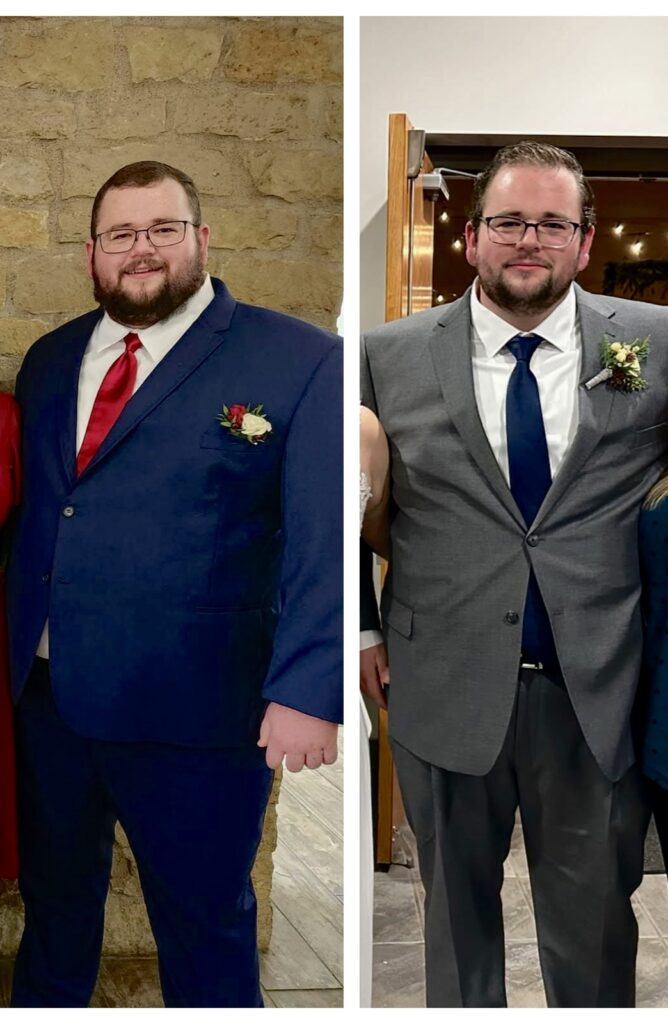
For me to tell you how I know what I know, you must first know where I came from. I started shooting around the age of 10. At that time, I was an overweight kid, but not prohibitively so. I was not first in line in gym class, but I could still play sports and live an active life. I gained weight as the years went on. By the time I graduated High School, I was obese and struggled to do physically strenuous tasks, but lived my day-to-day life just fine. But I definitely was not playing any sports or doing much that was active outside of a daily walk. I had a horrendous diet, I was inactive, and I did not care about my personal health.
I make it a point to keep my career out of the project here because most of the time, it doesn’t matter. But today it does. In 2020, I went to school to become an EMT. I was 6’3″ and 340 pounds. I looked unprofessional in my uniform, and I had a hard time kneeling, crouching, and moving in tight spaces. But I passed the class. There were no physical requirements where I went to school. I was judged only on my medical knowledge and my ability to prove my hands-on skills. As long as I could do that, then I was doing what they looked for. After school, I went on to be hired at a fire department as an EMT only. And for those that don’t know, in many areas, fire departments have EMS personnel who respond to medical emergencies. This is often in place of something like a county-wide EMS agency that performs EMS only. Then came the day when my department told me I needed to go to fire school to be a fireman.
And on the first day of the fire academy, I was greatly humbled. I couldn’t keep up with just about anybody in my class, except for the people who were just as out of shape as I was. But I did some work on myself, changed my diet, and was able to drop a few pounds and make it through the first part of my fire academy. In 2021, I went back to finish part 2 of my fire academy. Still obese, I had done little to better prepare myself. I again struggled to keep up, but somehow made it through. Over those years, I was still an avid shooter. I shoot every week, or every other week, with my carry handgun (most of the time a Glock 19), and once a month with my home defense rifle (a BCM 16″ carbine). I would struggle getting into positions, have to reholster or sling my weapon to get up from kneeling, sitting, and prone. Things continued at this pace for a couple more years.
For those who don’t know, in the fire service, it is not often that it is easy to eat a healthy, hot meal. We are often eating fast food and gas station garbage in between call-outs whenever we can. This caused me to gain more weight. At that point, I weighed about 350 pounds. Then came the day that I broke my shoulder. While transporting a patient, my driver hit a bump that sent me across the back of the ambulance. I had been holding onto a rail on the ceiling. With the odd angle in play and the sudden excessive weight placed on my right shoulder, it snapped. This injury took me out of service for just over 6 months. And for most of those six months, I sat around my house feeling sorry for myself about how life isn’t fair, and drowning my sorrow in garbage-tier food and alcohol. By the time I was ready to go back to work, I had gained over 20 pounds. I soon went on to work part-time at my fire department and went full-time working as a tech in an Emergency Room. There I was moving a lot, but I was also eating constantly. And continued to gain weight. This is where my shooting slowed down significantly due to barely being able to shoot from any position other than standing. I was so disgusted with myself that I couldn’t even do the hobbies and activities that once brought me so much joy and pleasure.
One day, one of my ER Docs was talking about doing the “Keto” diet for a few months. One thing led to another, and a lot of folks had decided to jump in with him. This is a doctor that I became good friends with, and looked at like my own father. I walked around the corner and decided to weigh myself to see where I was. I stepped on the scale, and grief and shame washed over my entire body. I weighed 405 pounds. I knew something had to change. I was losing myself day by day. I immediately walked back to the nurses’ station and said that I would be in for keto. We all agreed to start a strict keto diet on January 1 and run it until March 31. Things were starting to move.
I noticed that as I lost weight I noticed it was easier to live my life. Daily activities became easier, shooting became easier, and movement became easier. In those three months, I had lost 50 pounds. My life was getting so much better. I was beginning to go back to shooting a variety of positions. I was becoming more active. I started doing interval running to increase my stamina and cardio health. I took a 9-month break from keto and focused on physical fitness and maintaining my weight loss. After the 9 months were over, I started keto again. This time, I lost another 35 pounds. I could not have been happier with the progress thus far.
Where I Am At
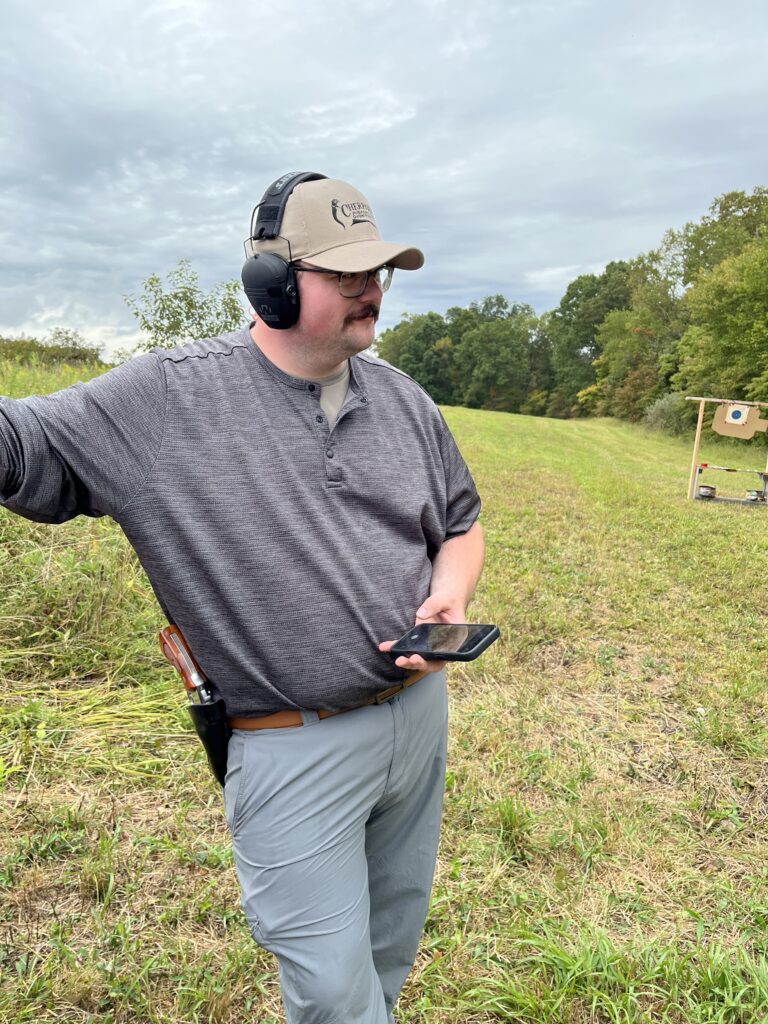
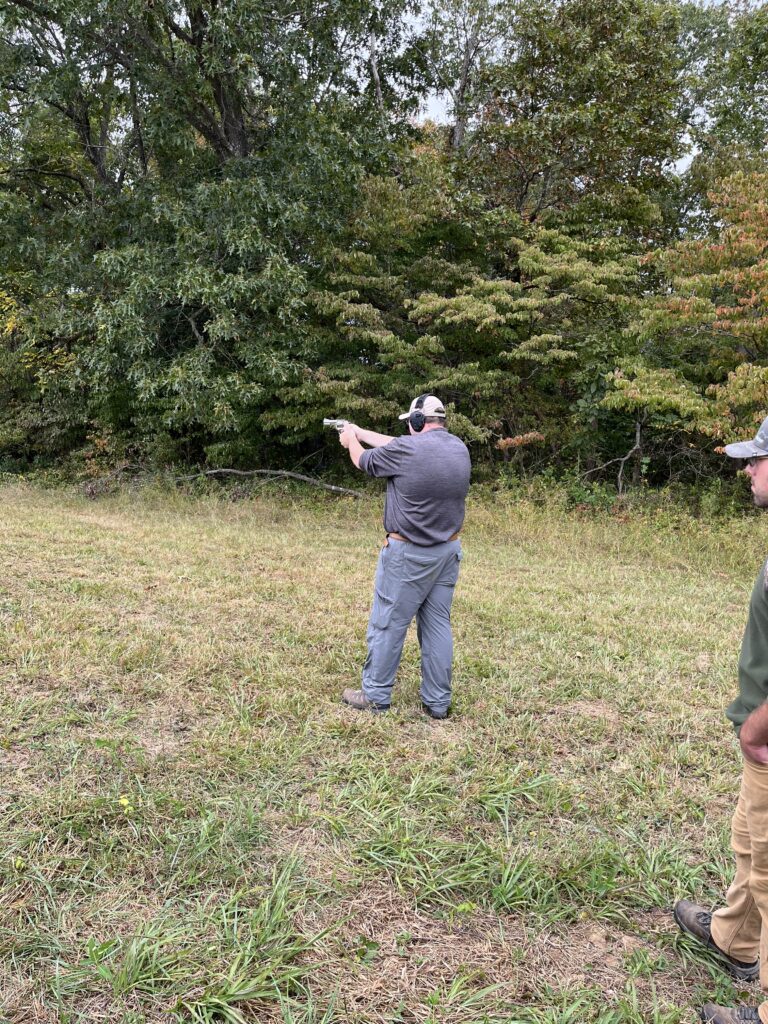
This is the most recent picture I have of myself. It is from a recent range trip. That shirt is about 2 sizes too big, but it is comfortable and I cannot find one like it in a size that fits, so it stays for now.
At the time of writing this, I have done a couple more cycles of keto, while maintaining my weight loss in between. Up to this point, I have lost 120 pounds, and both my life and marksmanship have greatly improved. I can run. I can hike. I can get into field expedient positions and hold them long enough to get off accurate shots. I am currently on a break from running due to a knee injury (not related to running), but I look forward to getting back to it once I am rehabbed from the injury. At this moment, I stand 6’4″ and 285 pounds. I still have a long road ahead, but I have made significant progress along the way.
Where I am Going
Let’s look at where I need to get to. After several conversations with my primary care physician, we have agreed that, for my height and build, a likely healthy weight would be between 220 pounds and 240 pounds. Of course, we won’t know for sure until I make it closer to that goal. While I have this objective goal, I want to hit on some of the personal goals I have that relate to shooting and marksmanship.
1.) I want to be able to run an 8-minute mile. I feel that while running isn’t directly related to marksmanship, the stamina associated with it most certainly is. Most “real” shooting is done under duress. Whether it be a shot at a deer with your heart rate elevated, or a self-defense shooting where one may have to quickly retreat to access their gun and make their shots. Even competition shooters shoot under duress. Regardless of your discipline, I cannot think of a single one where you would not be better served by being physically fit. Now I know just as well as anyone, this is easier said than done. Losing weight is simple in theory, but difficult in execution. And 8 minutes is just a number I picked; when I get closer, I will fine-tune that number.
2.) I need to make it to the point of being able to shoot from all common field positions with ease. It does not matter how well I can shoot from the kneeling position is while I am aiming at Bambi, he can hear me breathing from two hollers over.
3.) I need to be able to hike great distances and then make accurate shots. Similar to what can be done on an Elk hunt. Many disciplines of shooting require walking or hiking a great distance. Some that distance may be a couple of miles, others that distance may be 15-20 miles a day. While I currently do not have the opportunity to do hunts that cover 15-20 miles a day, I would like to, and when that opportunity presents itself, I need to be physically ready to rise to the occasion.
4.) I need to be able to perform physical activities and then shoot. A big benchmark for this is to be able to do Paul Howe’s 100-7 drill. For those unfamiliar, there are many executions of this on YouTube with better explanations than what I can provide. While many shoot this drill with tactical carbines, it really can be shot with anything. Garrett and I look forward to shooting this both with carbines and lever guns alike, as well as incorporating our handguns into the mix.
So, what have I learned along the way that may be able to help you in your endeavors?
What I Have Learned Along the Way
Here are some of the things I have learned along the way.
1.) Losing weight is a marathon, not a sprint. I did nto get to 405 pounds overnight, I shouldn’t expect to get back to 220 overnight either. This is a long road full of difficulty and stress. But the reward that awaits at the end is what makes it all worth it.
2.) There are times you will look at the scale and notice that you have gained a couple of pounds despite doing everything right. This is normal and not your fault. I have said before that I am not a doctor. So I cannot explain the metabolic reasons and processes as to why this phenomenon occurs, but it is something I have seen with every person in our group that did keto, which, for reference, was 15 people.
3.) Taking a break can be beneficial over just going full bore, start to finish. Especially when you are in the boat that I was. Because I am relatively young, my body can “shrink” its skin if I give it ample rest time. Hopefully, this will prevent the need for some kind of surgery to have the excess skin removed after it is all said and done. But I won’t be able to verify this until I reach my end goal. Also, the human body is constantly searching for a state of homeostasis. This means the body believes that it should be a certain way and will try to maintain that. Taking breaks allows the body to get used to the new lack of weight and helps prevent weight gain, at least in my experience.
4.) Consistency is key. Just because you broke for one meal or one day, doesn’t mean you have entirely screwed the plan. Just get back on track. Even if you have a bad week or a bad month, none of that will matter in the end. All that matters is that you stick with it. You will make it, just stay the course.
5.) You cannot out-exercise a crap diet. One of the things I hear often from folks wanting to lose weight is “I need to hit the gym more”. Going to the gym is definitely beneficial, but it won’t work off the 3 sleeves of Oreos that you wolf down afterwards. The first two rounds of keto I did, I did no exercise with it other than a walk 3 times a week. And that was more to get my dog up and outside than it was for me to lose weight. Now I work out, but again, this isn’t to lose weight. This is to build up my body from past injuries, to prevent further injuries, and to improve mental resilience and discipline.
The Keto Diet
Many people have diet advice. Some good and some bad. Many people praise the keto diet, and many curse it. I am not here to argue with people on this. I am here to state what has worked for me. And I would say that so far, a 120-pound weight loss has most certainly proved that the keto diet has worked for me. And in my off periods, my weight has stayed within a 10-pound range, 5 pounds up, 5 pounds down. You do not have to like keto, you do not have to do keto, just find something that works for you. Also, talk to your doctor; there are some people with certain medical conditions for whom keto is not right. But don’t tell me keto is useless and doesn’t work. Because I am missing 120 pounds, that would say otherwise.
But some may be asking what exactly the keto diet is. I will give it to you in a nutshell. Essentially, the keto diet is a very low-carb diet, where more fats and proteins are consumed. I used a benchmark of 25 or fewer carbs per day, but some sources have different levels. Do some investigating and testing to see what works best for you. Mainly on keto, I eat meat, vegetables, cheese, black coffee, unsweet tea, and butter. Those who prefer a more diverse diet can definitely add to it, but I like to keep things simple. Also, meal prepping helps a ton. Pick a few meals that you like and prep them for the week. I can tend to eat very similar foods frequently and not tire of them. Some can’t do that, and that is okay, just find what works for you. My three staple meals are omelets, fajitas, and bunless burgers. A salad with grilled chicken is also an honorable mention.
I am not an expert on keto, or diets in general, for that matter. What I am is a man who made a plan and stuck to it. And in the end, that is all that matters. One of my biggest pieces of advice is “do not take advice from someone who isn’t where you want to be”. In other words, don’t take diet advice from a mouth breather who cannot walk across the hall except to get another Mountain Dew.
Friends, I hope this has inspired you to work on yourselves wherever you need improvement. If you have any questions on how I did any of this, either comment or head over to the contact page and shoot me an email. I will do my absolute best to answer.
Until next time, friends
Chuck