
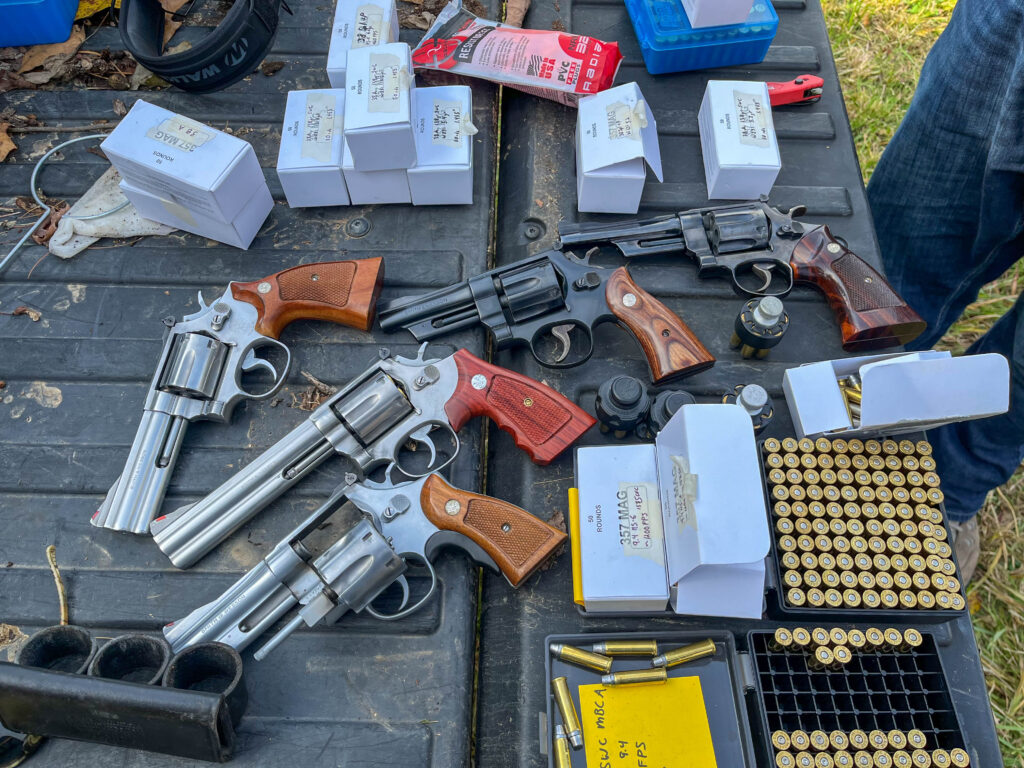
We all love it when things are going well, but none of us wants something to go wrong with our guns. Unfortunately, I had something go wrong on my most recent range day. I consider the Smith and Wesson revolvers to be some of the most reliable and well-built guns on the planet. However, they are mechanical devices that can fail. They can especially fail when someone does some kitchen gunsmithing on them. Buying used guns is one of my favorite things about shooting. Most used guns are in excellent shape, have not been shot much, and are quite a bit cheaper than the same gun, new from the factory. But sometimes this is not the case. Sometimes, folks get to messing around with the internals of guns they are not qualified or informed to work on.
Recently, I purchased a Smith and Wesson Model 28-2, Highway Patrolman, with a 4-inch barrel. This has been one of the guns I have been searching for for several years. I am a massive fan of the Smith and Wesson N Frame revolvers, and I already had my 5-inch Model 27-2, but I wanted a gun that I could shoot more and not feel bad about. I do shoot that 27, but I try not to beat it up too much. So I found my Model 28. For those unaware, the Model 28 is the same as the Model 27, just with less polishing. I like the 4 to 5-inch barrel N Frames, but the Model 28, to my knowledge, was never made in a 5-inch barrel, so I chose the four-inch model. I inspected the revolver in the store before I bought it. My inspection procedure usually includes: general condition of the firearm, timing, lock-up, yolk end-shake, rifling, screw heads (checking for deformity of the head, indicating that someone who did not know what they were doing has been inside the gun), chamber holes (checking for cuts for moon clips or cylinder chamfers), and condition of the sights (checking for broken blades). By all my inspection criteria, this revolver looked to be in excellent shape. One apparent thing was that the gun had been refinished, but I did not mind. But there is a big problem: refinishing can conceal several problems.
My first couple of range trips, I only shot factory 38 Special or low-pressure handloads. With this ammunition, I saw no problems with the revolver. And I shouldn’t have, this is one of the most durable 357 magnums on the market. But on my last range trip, I had some hot 38 Special (the original load from our “Reloading the 38 Special” series) and some 357 Magnum handloads. I decided to use the Model 28 for some chronograph work to compare its 4-inch barrel velocities to the 4-inch barrel on my Model 686, which I normally use for load development. I shot the first cylinder of 357 Magnum, and when I went to eject the casings, they only ejected approximately a quarter of an inch, like this.
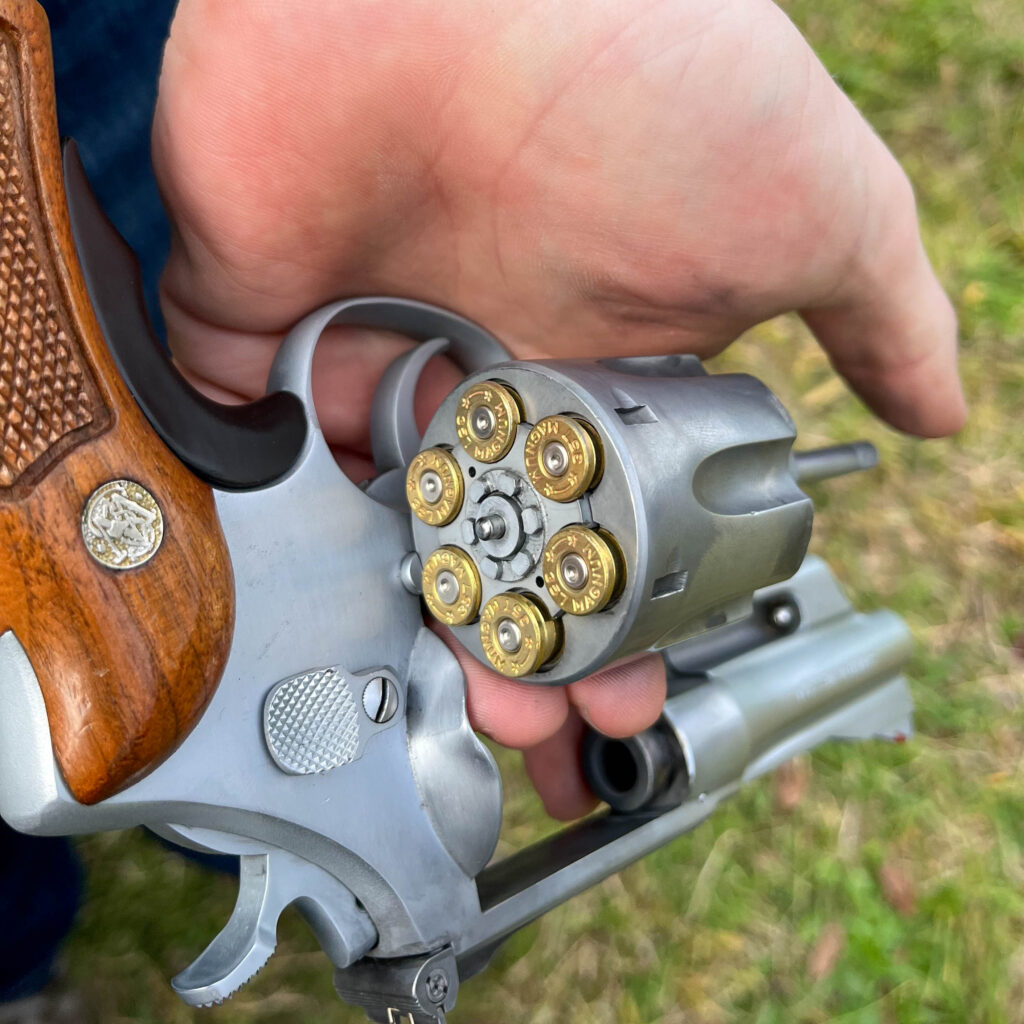
That initial quarter inch of ejection was achieved with thumb pressure, but after that, the ejector rod wouldn’t budge. I turned the gun muzzle to the sky and hit the ejector rod with my palm. Still, the cases wouldn’t move. We took a crew driver, placed in through the front of the cylinder, and had to beat the cases out. And I do mean beat them. Several strikes on each case were able to free them. This is the point where I would expect you to be concerned about how hot the 357 loads really are. But that is the interesting part, they are within published load data. According to Hodgdon’s Reloading Data Center, the load is as follows:
- 357 Magnum case
- Small Pistol Magnum Primer
- Starting Charge of HS-6 @ 8.0-grains
- Max Charge of HS-6 @ 9.5-grains
- 158-grain bullet
I did change a couple of things about this load. The first thing is the primer. I have found that there is no need to use a magnum pistol primer with HS-6, so I use a Standard Small Pistol Primer CCI #500. I pulled the load data for the Hornady XTP load data. I use the Missouri Bullet Company 158-grain SWC cast to 18 BHN. This hardness allows for lead bullets to be pushed to the same velocity as jacketed bullets. I use this same bullet for 38 Special loads, as well as 357 Magnum loads using H-110 and Lil’Gun powder, pushing bullets to nearly 1,600 FPS, and have yet to have an issue with accuracy, leading, or pressure. And for this particular, I was using 9.4 grains of HS-6.
Knowing that we are within published load data, and knowing that I have used this load in all of my other 357s, as well as a few other revolvers, why am I having these issues? The first thing I looked at was whether or not my ejector rod had bent; however, I quickly found that this was not the case. Strangely, the cases had ejected slightly before becoming stuck. Usually, if you have a stiff case, it is only one, and it is almost unheard of to have all 6 be stuck or split at the same time. I thought this must be a pressure issue, which was still strange that it showed up in this gun, but it was the best I had. But I had fired this 357 load through several other revolvers and never had an issue. Lucky for me, I had another 4-inch Model 28-2, as well as my 5-inch Model 27. I ran this load through both revolvers, and it fired and ejected perfectly. So I picked up the two L Frames we had out, two Model 686 No Dashes, one with a 4-inch barrel and the other a 6-inch barrel. In theory, the L Frame should show issues with pressures before the N Frame. Both L Frames worked perfectly with this load. So how, out of 5 revolvers, am I having issues with just this one load? So I decided to step down to the 38 Special loadings. I fired the first cylinder of 38, and it was still stuck. I can’t be mad about this, because that load is over max data. I had stepped down charges of Winchester 231, all topped with the same MBC 158 SWC bullets. The powder charges stepped down as follows: 6.0, 5.8, 5.6, 5.4, 5.2, and 4.6 grains. According to my load manuals, the 4.6 grain loading is a standard pressure, non +P loading. Except, the extraction was still sticky. While the cases did not need to be beaten out with a screwdriver, they did still require far more pressure than what should have been necessary.
Luckily, we had some Freedom Munitions Remanufactured 38 Special 158 grain. So we cycled this load and saw no issues. One thing to note is that most factory 38 Specials are underpowered and underpressured. This was quickly becoming evident. Every round that caused issues through that Model 28 was also fired through the other four revolvers, and none of them showed an issue. This left me confident that I had some sort of chamber issue.
After beating the cases out of the chamber, I closely examined the cases and found a ring made by the cylinder on each of them. And each of these marks was as uniform as could be expected.
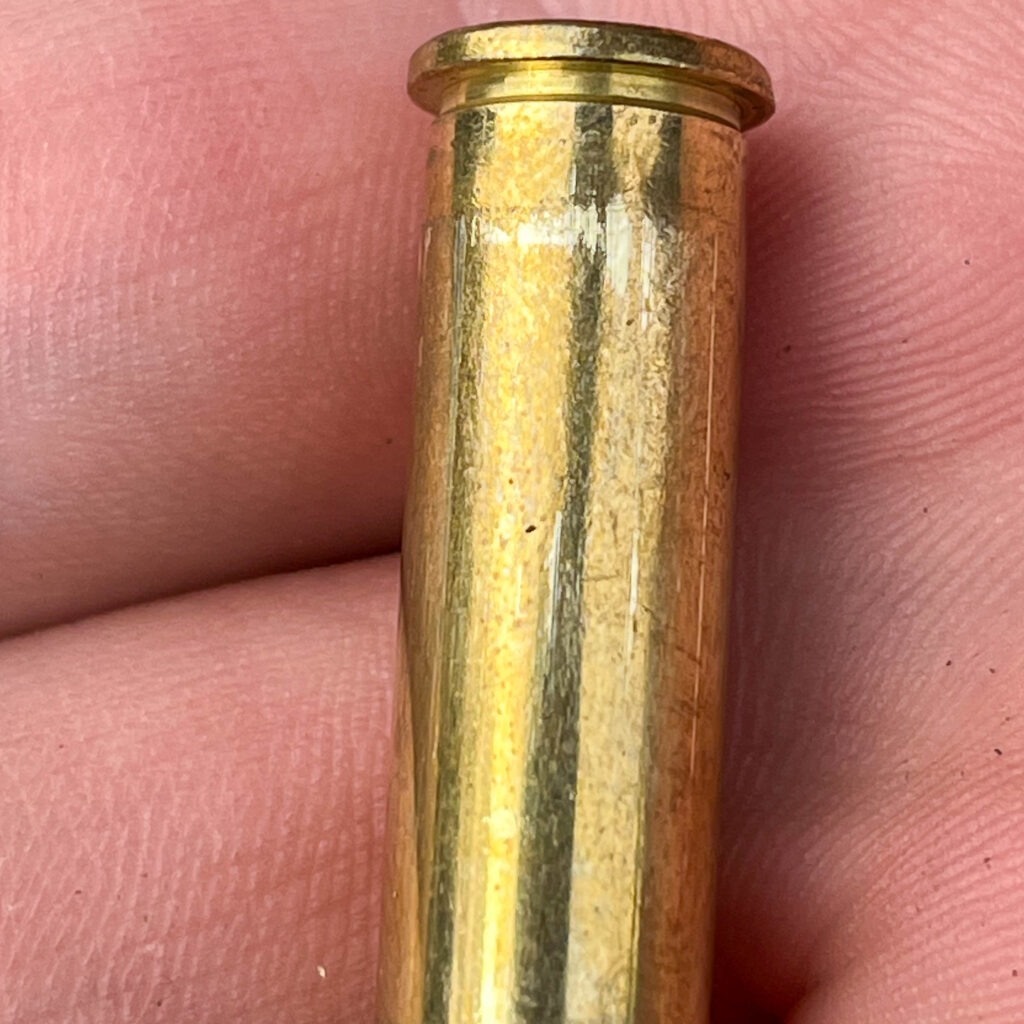
I fired numerous rounds of this ammunition, and they all showed these markings to some degree, but it was less and less as the powder charges decreased. I also chronographed each of these loads through the gun as we were having these issues. What we were finding was that any load over 850 FPS was getting stuck. This leaves me with a large-frame revolver that can only fire standard-pressure, low-velocity loads. This is not acceptable for the type of shooting that I do. If I want a 38, I will get one of my K Frames and save the weight.
So now I am left with a predicament. What do I do with this gun? Do I sell it? Do I buy a new cylinder and have it fitted to the gun? This would be ample time for me to hear from you all. What would you do if in my position? Head down to the comments and let me know.
Until next time, friends
Chuck